
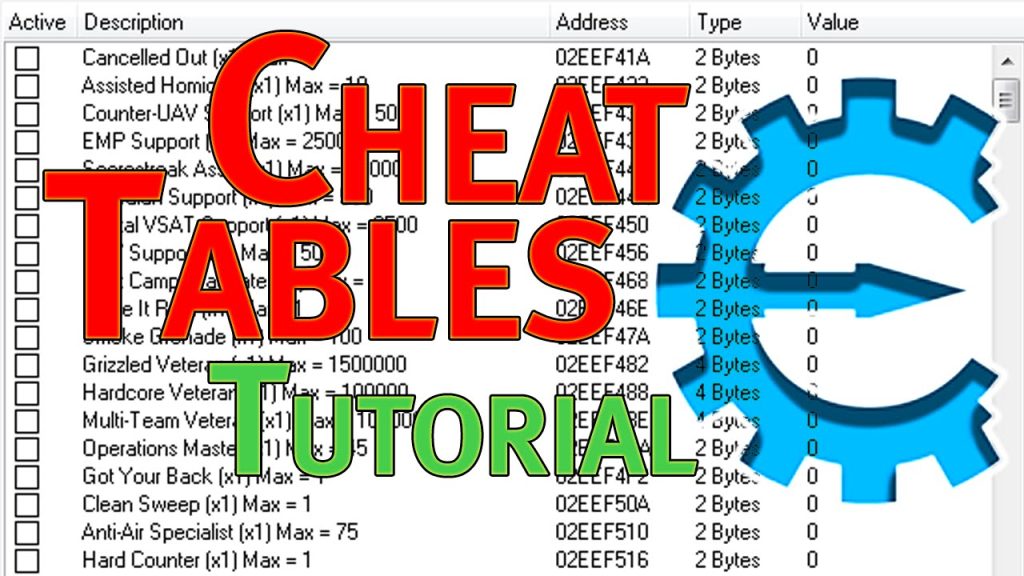
Cheat Engine Tables: Your Ultimate PC Game Trainers Tutorial
Ever found yourself staring at an impossible boss, a dwindling resource meter, or a painfully slow progression in your favorite PC game? We’ve all been there! That’s where the magic of Cheat Engine tables comes in. These powerful tools can transform your gaming experience, turning frustrating roadblocks into triumphant victories. Today, we’re diving deep into the world of PC game trainers, specifically focusing on how to effectively use Cheat Engine tables to unlock new levels of fun and challenge. Whether you’re a seasoned gamer looking to explore game mechanics or a beginner seeking a little extra edge, this comprehensive tutorial will equip you with the knowledge to master Cheat Engine and elevate your gameplay.
Quick Hacks: Example Cheat Engine Table Snippet
Let’s peek at what a basic Cheat Engine table might look like for a hypothetical game. Imagine you’re playing a simple resource management game.
| Cheat | Value | Hotkey | Description |
|---|---|---|---|
| Infinite Gold | 999999 | F1 | Never run out of gold again! |
| Max Stamina | 100 | F2 | Unlimited actions, no waiting. |
| God Mode | 1 | F3 | Become invincible to damage. |
| No Cooldowns | 0 | F4 | Instantly reuse abilities and skills. |
This is just a tiny glimpse, but it shows the immediate impact a table can have. Now, let’s get into the nitty-gritty of how these work and how you can leverage them.
Understanding Cheat Engine and Its Tables
So, what exactly is Cheat Engine? At its core, Cheat Engine is a free, open-source memory scanner/debugger tool for Windows. It allows you to scan for values in the memory of running processes, which can then be modified. This means you can change things like your health, ammo, or in-game currency.
However, manually finding these values can be a tedious and complex process, especially for more intricate games. This is where Cheat Engine tables shine. A Cheat Engine table (often a .CT file) is essentially a pre-made script or set of instructions for Cheat Engine. These tables are created by community members and can automate the process of finding and modifying specific game values. They often include a user-friendly interface within Cheat Engine itself, allowing you to toggle cheats on and off with ease.
Why Use Cheat Engine Tables for PC Game Trainers?
The allure of using Cheat Engine tables as PC game trainers is multifaceted. It’s not just about making games easier; it’s about exploration, experimentation, and overcoming barriers that might otherwise halt your progress.
- Accessibility: For players struggling with difficult sections, Cheat Engine tables offer a way to bypass frustrating challenges and enjoy the game’s narrative or core gameplay loop.
- Exploration: Want to see what happens if you have unlimited resources? Or perhaps test out endgame gear without the grind? Tables let you experiment with game mechanics in ways not intended by the developers, leading to unique discoveries.
- Learning: By examining how tables manipulate game values, aspiring modders and developers can gain insights into game programming and memory management.
- Replayability: Existing games can feel fresh again when you introduce new challenges or simply play around with modified game states.
The Core Mechanics: How Cheat Engine Tables Work
To truly master using Cheat Engine tables for PC game trainers, a basic understanding of the underlying mechanics is helpful.
Memory Scanning and Modification:
When you run a game, it loads data into your computer’s RAM (Random Access Memory). This data includes things like your character’s health points, the amount of gold you possess, or the position of enemies. Cheat Engine works by scanning this RAM for specific values.
For instance, if your health is 100, Cheat Engine can scan for all memory addresses containing the value “100.” If you take damage and your health drops to 90, Cheat Engine can then perform a new scan, narrowing down the possibilities to addresses that changed from 100 to 90. This process of “guessing and checking” is how individual values are located.
Cheat Engine Tables – The Shortcut:
Instead of you manually performing these scans, Cheat Engine tables come pre-loaded with the “answers.” The creator of the table has already gone through the painstaking process of identifying the correct memory addresses for various in-game elements. They then package these addresses and the instructions on how to modify them into a .CT file.
When you load a table into Cheat Engine, it tells Cheat Engine: “Look for this specific value at this memory address, and when this button is pressed, change it to this new value.” This is what enables features like “Infinite Health” or “Max Ammo” with a single click or hotkey.
Scripting and Pointers:
More advanced tables utilize scripting and pointers.
- Scripts: These are more complex instructions that can perform actions beyond simply changing a value. For example, a script might constantly check if a certain condition is met and then apply a change, or it could trigger a series of modifications simultaneously.
- Pointers: Game memory addresses can change each time you launch the game or even during gameplay (dynamic addresses). Pointers act like signposts. They point to another memory address, which in turn points to the actual value you want to modify. This makes the cheats more robust and less likely to break when the base address shifts.
Getting Started: Your First Cheat Engine Table
The journey begins with downloading Cheat Engine itself. Visit the official Cheat Engine website and download the latest stable version. Be cautious and only download from the official source to avoid malware.
Once Cheat Engine is installed, here’s the typical workflow for using a table:
- Find a Reliable Cheat Engine Table: This is crucial. Look for tables from reputable gaming forums, dedicated modding sites, or communities focused on specific games. Always scan downloaded files with your antivirus.
- Launch the Game: Start the PC game you want to cheat in.
- Launch Cheat Engine: Open Cheat Engine.
- Attach Cheat Engine to the Game Process: In Cheat Engine, click the “Select a process to open” button (it looks like a computer with a magnifying glass). A list of running processes will appear. Find your game’s executable (e.g.,
game.exe) and select it. - Load the Cheat Table: Go to “File” > “Load Cheat Table” and select the
.CTfile you downloaded. - Activate Cheats: The table will appear in a separate window or within Cheat Engine. You’ll typically see checkboxes or buttons next to the cheats. Click the checkboxes or activate the desired cheats. Some tables also have hotkeys assigned, which will be listed in the table’s description.
Important Note: Not all games are compatible with Cheat Engine, and using it may violate a game’s terms of service, potentially leading to bans in online multiplayer games. Always be mindful of where and how you use these tools.
Navigating Cheat Engine Tables: Key Elements
When you load a .CT file, you’ll encounter several common elements:
- Cheats/Options: These are the actual modifications you can enable. They are usually presented as checkboxes, toggle buttons, or sometimes input fields for specific values.
- Descriptions: Good tables will have descriptions explaining what each cheat does.
- Hotkeys: Many tables assign hotkeys (e.g., F1, Ctrl+T) for quick activation and deactivation of cheats without needing to switch windows.
- Scripts: If a cheat is more complex, it might be implemented as a script. These often have a small “Script” button next to them.
- Pointers: You might see options that explicitly mention “pointer.” These are usually more stable cheats.
- Version Specificity: Cheat tables are often created for a specific version of a game. Game updates can break these tables, requiring new versions.
Advanced Techniques for Mastering PC Game Trainers
Once you’re comfortable with the basics, you can explore more advanced techniques to truly become a master of Cheat Engine tables and PC game trainers.
Creating Your Own Simple Cheat Tables
While complex tables require significant effort, creating simple ones is surprisingly accessible.
- Find a Simple Value: Load your game and Cheat Engine. Attach Cheat Engine to the game process. Let’s say you want to find your current ammo count. Start with a value you know (e.g., 30 bullets). In Cheat Engine, enter “30” into the “Value” field and click “First Scan.”
- Modify the Value: Fire a bullet or reload to change the ammo count (e.g., to 29). In Cheat Engine, enter “29” into the “Value” field and click “Next Scan.”
- Repeat: Continue this process of changing the value in-game and scanning in Cheat Engine until you narrow down the results to one or a few addresses.
- Test and Verify: Double-click on the address that seems correct. You can then try changing its value manually in Cheat Engine (right-click > “Change value of selected cells”). If your ammo count changes in-game, you’ve found it!
- Add to Table: Right-click on the found address and select “Add this address to my current cheat table.” You can then give it a name, assign a hotkey, and set it to “Active” by default. Save the table.
Using Pointers for Stability
As mentioned, dynamic addresses are a common hurdle. Pointers help overcome this. If you find a reliable static pointer address, you can create a pointer that always leads to your desired value, even if the base address changes. This is a more advanced topic, often involving understanding memory structures, but many tables already incorporate pointers, so you benefit from them without creating them yourself.
Understanding Game Updates and Table Compatibility
Game developers frequently release updates. These updates can alter the game’s memory layout, rendering existing Cheat Engine tables useless.
- Check for Updates: When a game updates, look for updated cheat tables on the forums or sites where you originally found them.
- Table Creation: Some dedicated users will reverse-engineer the game after an update to create new tables.
- Manual Updates: In some cases, if you’re tech-savvy, you might be able to manually update a table by re-finding the changed addresses.
Troubleshooting Common Issues with Cheat Engine Tables
Even with the best tables, you might run into problems. Here are some common issues and their solutions.
Issue 1: Cheat Engine Crashes When Loading a Table or Game
- Cause: Outdated Cheat Engine version, corrupted table file, or conflicts with antivirus software.
- Solution:
- Ensure you’re using the latest stable version of Cheat Engine.
- Re-download the cheat table from a trusted source.
- Temporarily disable your antivirus software and try again. If it works, add an exception for Cheat Engine and the game’s directory in your antivirus settings.
- Ensure you’re running Cheat Engine as an administrator.
Issue 2: Cheats Don’t Work or Stop Working After a While
- Cause: Game update, incorrect game version for the table, or the cheat is an unstable pointer.
- Solution:
- Verify that you’re using the cheat table designed for your specific version of the game.
- Check if the game has recently been updated. If so, you’ll likely need a new version of the cheat table.
- Some cheats might be tied to specific game states. Try activating them at different points in the game.
- If the table has multiple options for the same cheat, try a different one.
Issue 3: Game Becomes Unstable or Crashes After Enabling Cheats
- Cause: Conflicting cheats, a faulty cheat script, or trying to push the game beyond its stable limits.
- Solution:
- Enable cheats one by one to identify the problematic one.
- Disable all cheats and re-enable them in smaller batches.
- Avoid enabling cheats that drastically alter core game mechanics simultaneously unless the table explicitly states they are compatible.
- Ensure you’re not attempting to perform actions that are inherently impossible or nonsensical within the game’s engine (e.g., giving yourself millions of hit points when the game only tracks up to 1000).
Issue 4: “Game detected cheat” or Anti-Cheat Measures
- Cause: Some online games have robust anti-cheat systems that can detect memory modification tools like Cheat Engine.
- Solution:
- NEVER use Cheat Engine or any cheat tables on online multiplayer games. This is the golden rule. Most anti-cheat systems will result in a permanent ban.
- If you encounter this in a single-player game, it might be a less sophisticated detection system. Ensure you’re not running Cheat Engine with excessive permissions or making overly obvious modifications. However, for most modern online games, attempting to cheat is a high-risk endeavor.
The Ethics and Responsible Use of PC Game Trainers
It’s important to approach the use of Cheat Engine tables and PC game trainers with a sense of responsibility. While they can enhance enjoyment, misusing them can detract from the intended experience for yourself and potentially others.
- Single-Player Focus: The primary domain for using cheat tables is in single-player games. This allows you to experiment and have fun without impacting other players’ experiences.
- Online Games: As repeatedly emphasized, avoid using any form of cheating in online multiplayer games. It ruins the fair play for everyone and can lead to severe consequences like account bans.
- Respect Developers: Remember that game developers pour immense effort into creating their games. While exploring game mechanics through cheats can be educational and fun, it’s also good to appreciate the intended challenges and progression.
- Community Contribution: If you find a table that works well, consider leaving a positive review or contributing to the community where you found it. If you learn to create tables yourself, sharing them responsibly is a great way to give back.
Frequently Asked Questions About Cheat Engine Tables
Here are answers to some common questions players have about using Cheat Engine tables for PC game trainers.
Q1: Is it safe to download and use Cheat Engine tables?
A1: Downloading Cheat Engine itself from the official website is safe. However, cheat tables are created by third parties. It’s crucial to download tables from reputable sources (like established gaming forums or dedicated modding sites) and always scan downloaded files with a reliable antivirus program before opening them. Be wary of unofficial sources that bundle software with the tables.
Q2: Can using Cheat Engine tables get me banned from games?
A2: In online multiplayer games, yes, absolutely. Anti-cheat systems are designed to detect memory manipulation, and using Cheat Engine will almost certainly lead to a ban. For single-player games, bans are generally not an issue, as there’s no online competition or adherence to server rules. However, always check the game’s terms of service if you’re unsure.
Q3: How do I find the right cheat table for my game?
A3: The best approach is to search for “[Game Name] Cheat Engine Table” on search engines. Look for results from well-known gaming forums (like Reddit’s PCGaming or specific game subreddits), dedicated modding websites, or communities that actively discuss game modifications. Always prioritize tables that have recent updates or positive user feedback.
Q4: What if a cheat table doesn’t work after a game update?
A4: Game updates often change the game’s memory structure, making old cheat tables incompatible. The solution is usually to wait for the creator of the cheat table (or another community member) to release an updated version for the new game patch. Keep an eye on the download page or forum thread for updates.
Q5: Can Cheat Engine tables be used on Mac or Linux?
A5: Cheat Engine is primarily developed for Windows. While there might be some unofficial ports or alternative tools for other operating systems that offer similar functionality (like GameGuardian for Android, or specific Linux tools), Cheat Engine itself is not natively supported on macOS or Linux. For Mac users, running Windows in a virtual machine or via Boot Camp is often the workaround.
The Future of Game Modification and Trainers
The landscape of game modification is constantly evolving. As games become more complex and online-centric, the challenges and opportunities for tools like Cheat Engine tables and PC game trainers shift. While direct memory manipulation might become more difficult in highly secured online environments, the spirit of modifying and enhancing game experiences persists. Community-driven mods, unofficial patches, and even developer-sanctioned modding tools continue to push the boundaries of what’s possible, offering players new ways to interact with and enjoy their favorite titles. The creativity of the modding community ensures that tools like Cheat Engine will remain relevant for a long time to come, especially for the vast world of single-player PC gaming.
Conclusion
Mastering Cheat Engine tables opens up a new dimension of PC gaming, allowing you to overcome challenges, explore game mechanics, and tailor your experience. By understanding how these tables work and following best practices, you can elevate your gameplay safely and effectively. Remember to always prioritize responsible usage, especially by avoiding online multiplayer environments. Dive in, experiment, and discover the full potential of your games!
Ready to transform your gaming? Start exploring the world of Cheat Engine tables today and unlock a new level of fun!
